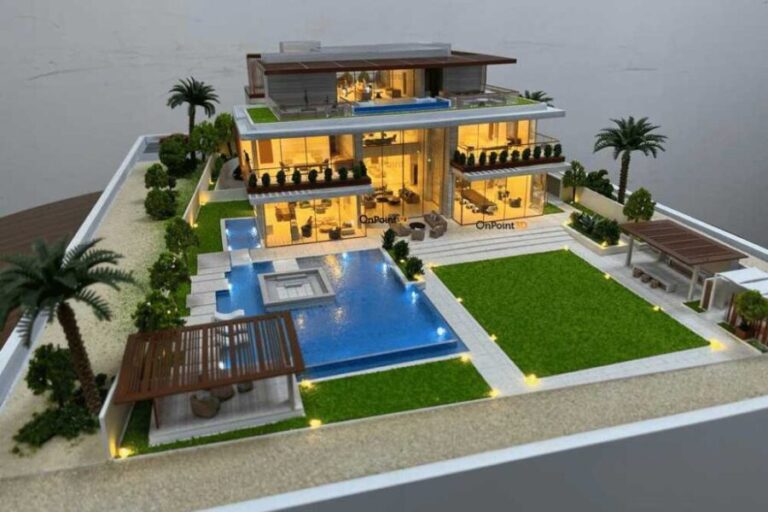
Architectural model making is an essential part of the design process, allowing architects and designers to visualize and communicate their ideas effectively. To create accurate and detailed models, several essential tools are used by model making companies in Dubai. Find here the key tools every model maker should have:
Cutting mat & self-healing cutting mats: A cutting mat protects surfaces when using sharp knives or blades, providing a stable work area. Self-healing mats feature small cells that close after being cut, prolonging the lifespan of the mat. They come in different sizes and colors, allowing users to organize components according to scale or category.
X-acto knife/stanley knife: An X-acto knife or Stanley knife is indispensable for precise cuts on foam board, cardstock, plastic sheets, and wood. Replaceable blades enable consistent performance without dulling quickly. Always use appropriate safety measures, such as cutting away from yourself and keeping them out of children’s reach.
Metal ruler & T-square: Accurate measurements are vital in architectural model making; hence having reliable measuring instruments is essential. A metal ruler provides straight edges for marking lines, while a T-square ensures right angles along longer edges. Both should ideally have millimeter graduations for greater precision.
Glue gun & adhesive: Hot glue guns are widely used in model making due to their versatility and quick bonding properties. Choosing the correct adhesive type depends on the materials being joined—for instance, cyanoacrylate (superglue) works well for plastics and metals, whereas PVA (white glue) is suitable for paper, cardboard, and wood. Be cautious when handling hot glue guns, as they can cause burns if misused.
Sandpaper & files: Finishing touches often require smoothening rough edges or corners. Sandpaper comes in various grits, which determine the coarseness or fineness of abrasions. Similarly, files help shape irregularities in hard materials like woods, metals, and plastics. Selecting the proper file type depends on the desired outcome – flat, half-round, square, round, or triangular profiles.
Laser cutter/engraver: Digital fabrication technologies like laser cutters and engravers revolutionized architectural model making by enabling faster production times, higher accuracy levels, and intricate details unachievable through manual methods alone. While expensive, these machines save valuable time and resources, especially when dealing with complex geometries or repetitive tasks.
3D printer: Additive manufacturing technology allows designers to create three-dimensional objects directly from digital files. It bridges the gap between physical and virtual environments, facilitating better understanding and communication of spatial relationships within designs. Although costly initially, owning a 3D printer opens up endless possibilities for experimenting with innovative forms and structures.




More Stories
The Best Drinks To Enjoy At A Saturday Evening Brunch
Payment Plans That Make Dubai Off Plan Property Accessible
How Moisturizer Creams Renew Tired Skin